
Quick answer
To choose a private label Christmas light manufacturer, evaluate the factory's control over the complete product system—not only its unit price or catalog. Ask for model-specific certification evidence, an approved sample process, written quality checkpoints, clear MOQ and tooling assumptions, peak-season capacity planning, packaging and documentation support, confidentiality terms, lot traceability, and a replacement-part plan.
The strongest supplier is the one that can turn your product brief into a repeatable specification and show how that specification will be protected from sample approval through mass production and after-sales service. Compare evidence for the exact product and target market; do not accept a generic factory profile as proof that every model or configuration is covered.
1. Define the private-label product program before contacting factories
A useful supplier comparison starts with the same written brief for every candidate. State whether you need seasonal mini lights, C7/C9 bulbs and socket line, permanent RGB or RGBW systems, accessories, or a coordinated range. Include the target country, sales channel, expected use environment, desired launch window, estimated volume, brand positioning, packaging format, and service expectations.
Separate required features from optional features. If the brief changes during quoting, the price, MOQ, certification scope, tooling, lead time, and sample result may also change. A controlled brief prevents buyers from comparing unlike proposals.
- Product category, dimensions, light color, wire color, connector, controller, and accessory requirements
- Target market, operating environment, sales channel, and applicable compliance expectations
- Forecast volume, launch date, packaging languages, label content, manuals, and carton configuration
- Required samples, test reports, spare parts, warranty process, and approved-substitution rules
2. Confirm who controls manufacturing and product decisions
Ask which processes the supplier performs, which components come from partner factories, and who owns the final specification. A trading company, assembler, and vertically integrated manufacturer can each be suitable, but the responsibilities must be transparent.
Identify who approves materials, manages engineering changes, maintains quality records, and answers a corrective-action request. If the sales contact cannot identify the responsible technical and quality teams, changes may be difficult to control after an order is placed.
3. Evaluate complete-system development capability
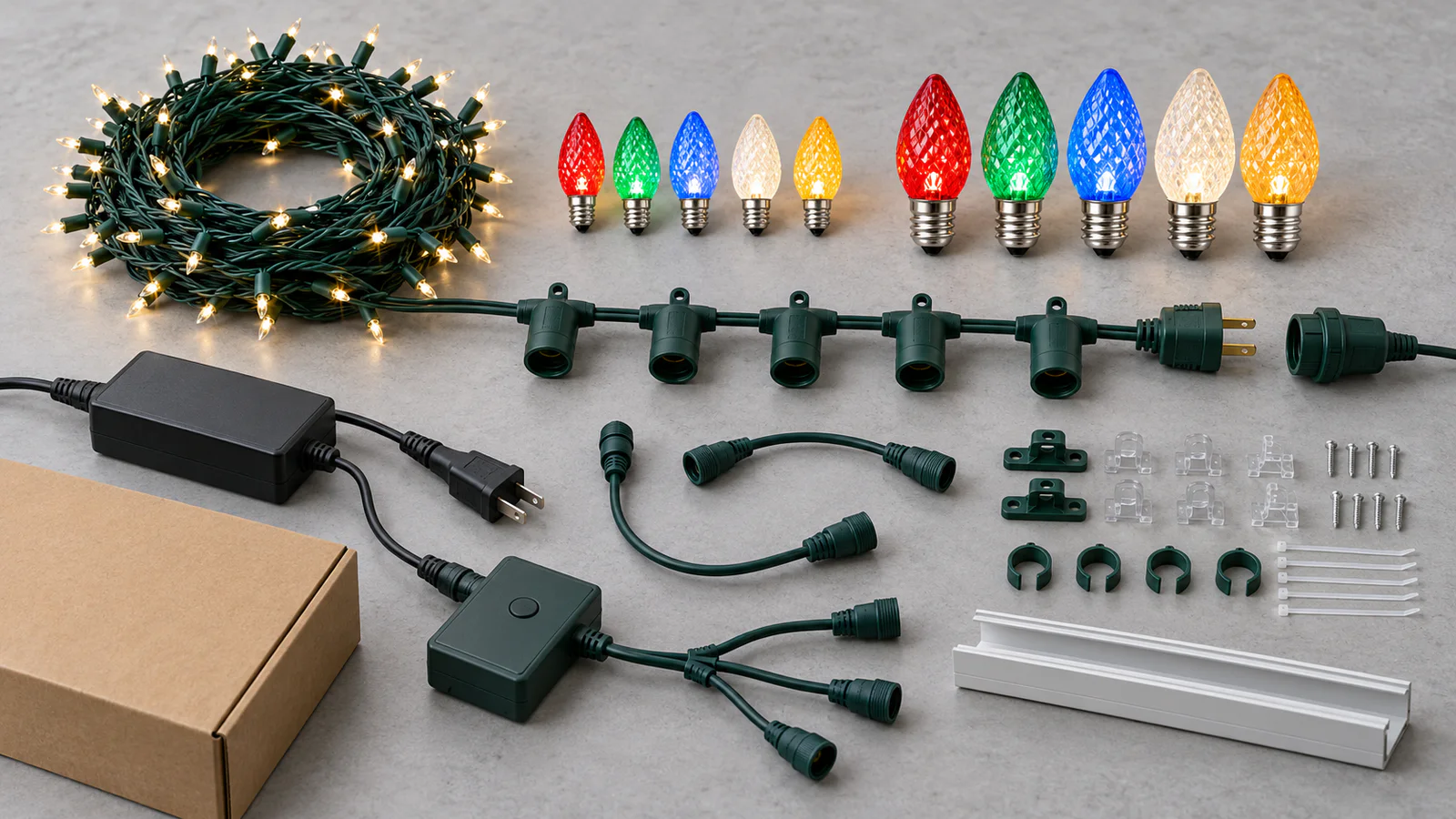
Christmas lighting products work as systems. Bulbs, sockets, wire, plugs, power supplies, controllers, connectors, mounting parts, and packaging can affect compatibility and field performance. A supplier that quotes only the visible light source may leave important interfaces unresolved.
Request a component list and a responsibility map for the finished configuration. For connected or permanent lighting, also define firmware, app, controller, electrical architecture, and update responsibilities. For C7/C9 or mini-light programs, confirm the approved bulb-to-socket, wire, plug, and connection combination.
4. Verify certification scope for the exact model and market
Do not treat a certification logo, a factory audit, or a certificate for a similar product as proof for the item you plan to buy. Request the listing or file information for the exact model, manufacturer, voltage, construction, components, and intended market, then verify it through the official directory of the named certification body.
Ask the supplier to explain which changes require engineering review or new testing. A different wire, plug, connector, power supply, controller, enclosure, or production location can affect the approved construction. UL and ETL are separate certification programs; use the directory and documentation that match the mark being claimed.
5. Review the sampling and approval process
A professional sample process has defined stages, acceptance criteria, and written sign-off. A typical sequence may include an appearance sample, an engineering or functional sample, a packaging sample, and a final approved reference sample. The exact sequence depends on product complexity, but every supplier should explain what is being approved at each stage.
Create a signed golden sample or equivalent approved record and link it to drawings, bill of materials, color standards, firmware versions, packaging artwork, and test criteria. Require written approval before any substitution or change is introduced into production.

6. Ask for a product-specific quality-control plan
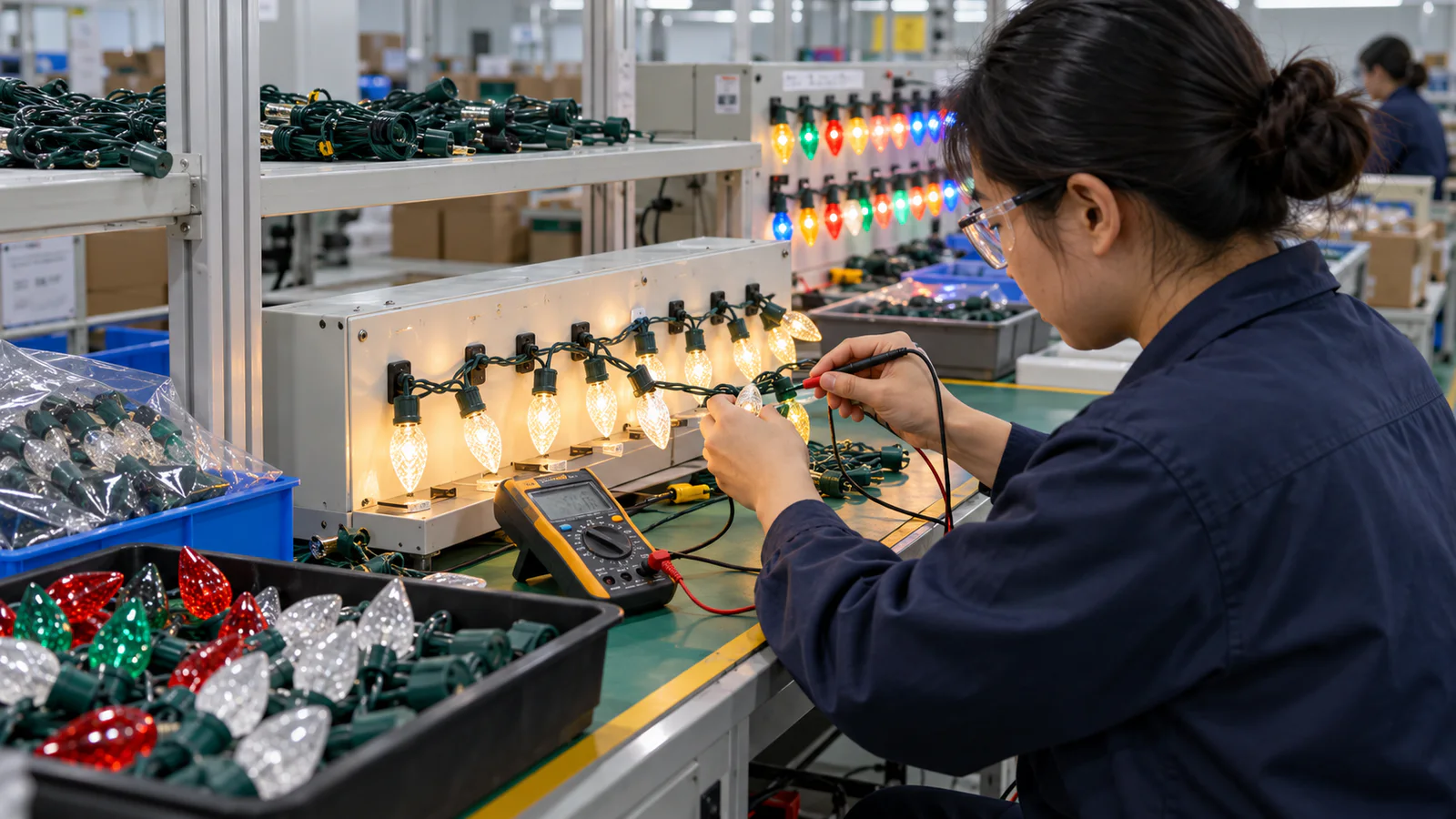
The phrase strict quality control is not a quality plan. Ask what is inspected at incoming material, first article, in-process assembly, end-of-line testing, packaging, and shipment release. The plan should identify the characteristic, method, frequency, acceptance rule, record, and person responsible.
Relevant checks vary by product but may include dimensions, polarity, continuity, electrical safety tests, waterproofing or environmental checks, connector retention, color consistency, controller functions, burn-in, packaging verification, and lot traceability. The applicable standard and test method must be defined for the exact product rather than copied from an unrelated model.
7. Understand MOQ, tooling, and customization boundaries
There is no universal MOQ for private label Christmas lights. A standard product with existing components and simple branded packaging may have a different minimum from a custom housing, wire color, connector, controller, app, mold, or certified construction.
Ask suppliers to separate MOQ by product, color, packaging, and production run, and to itemize tooling, engineering, artwork, testing, certification, and setup costs. Also ask whether multiple SKUs can share a production minimum and what happens if forecasts change. A useful quotation states its assumptions instead of presenting one unexplained number.
8. Evaluate production capacity and lead-time control
Capacity should be evaluated against your launch calendar and peak-season risk, not as a single verbal output number. Ask how the supplier plans critical materials, confirms production windows, controls subcontracted processes, handles late artwork, and communicates delays.
Request a milestone schedule from approved sample and deposit through material preparation, production, inspection, packing, and shipment readiness. For multi-country sourcing, confirm which work is performed in each location and which origin, import, and documentation requirements apply to your transaction.

9. Confirm branding, packaging, and documentation support
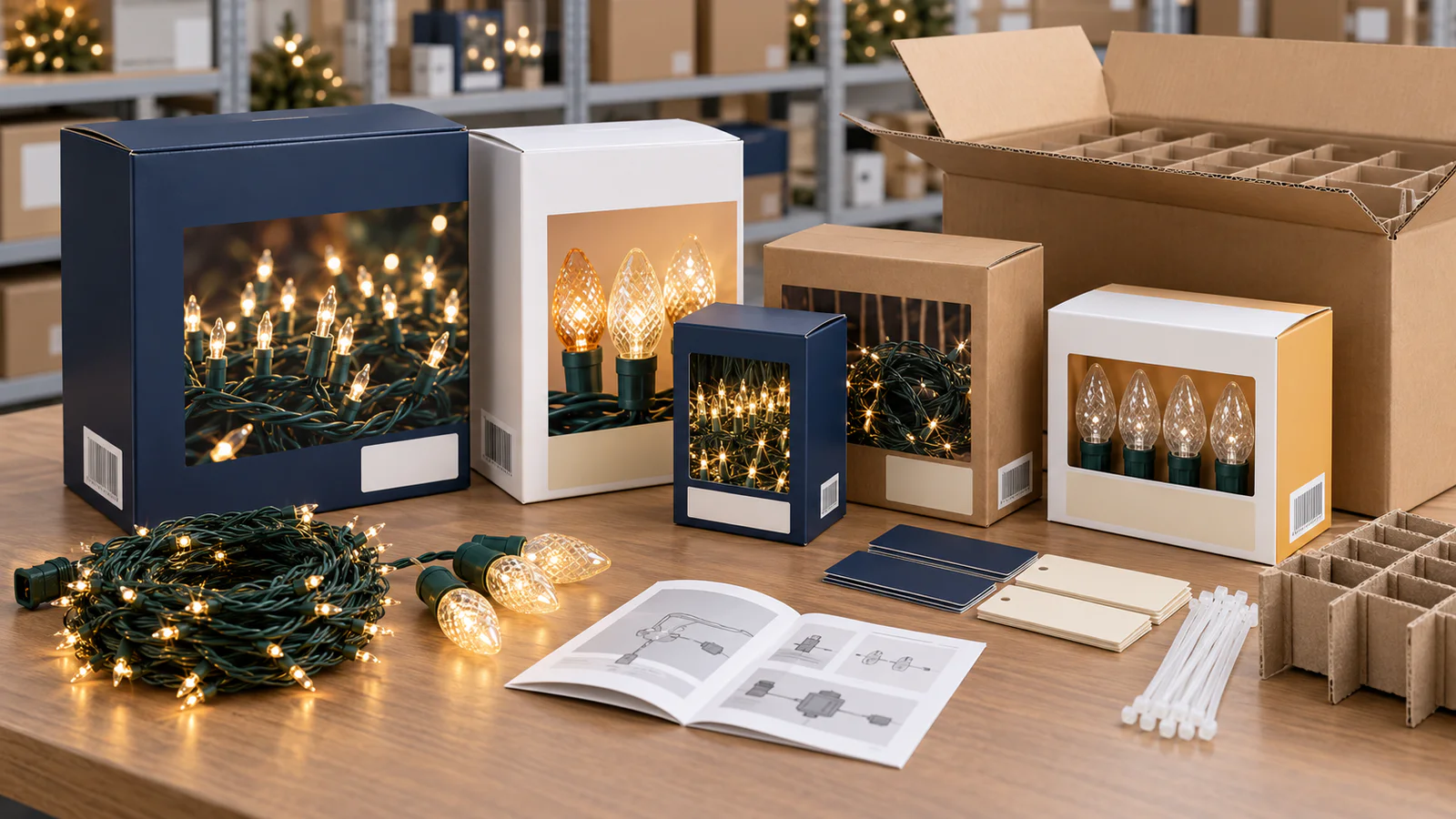
Private label involves more than printing a logo. Define the product label, retail or project packaging, master carton, manual, warning language, barcode, country-of-origin marking, photography, spare-parts identification, and revision control required for your channel.
Ask who checks artwork against product and market requirements and how revisions are approved. Packaging samples should be reviewed with the product because incorrect labels, missing components, weak internal protection, or mixed revisions can delay a launch even when the lights themselves are acceptable.
10. Protect confidential information and tooling ownership
Use a written NDA or confidentiality agreement before sharing sensitive product plans, drawings, firmware, customer data, pricing, or launch information. An NDA is only one layer: the supply agreement should also address ownership and authorized use of drawings, molds, tooling, packaging files, software, test fixtures, and custom components.
Define who can approve changes, whether subcontractors may access confidential materials, how tooling is identified and stored, and what happens when the relationship ends. Have the relevant agreements reviewed by qualified legal counsel for the jurisdictions involved.
11. Plan warranty, claims, and replacement-part support
A brand owns the customer experience after shipment, so the manufacturing plan must include service. Define the warranty workflow, evidence required for a claim, response times, failure-sample handling, lot traceability, root-cause and corrective-action process, and responsibility for approved remedies.
For systems with replaceable components, agree on service-stock quantities and the period during which compatible parts can be supplied. Record any approved component or firmware change so replacement parts remain compatible with products already in the field.
12. Compare total program risk—not only unit price
The lowest quotation can become the most expensive program when it excludes testing, tooling, packaging work, inspection, spare parts, engineering changes, or corrective action. Compare landed commercial assumptions together with the probability and cost of delay, rework, field failure, and lost customer trust.
Use a weighted scorecard. Give more weight to evidence that protects the launch: exact-model compliance, approved samples, process control, traceability, communication, service support, and a complete-system owner. Price still matters, but it should be compared only after scope and risk are aligned.
How Permanent Lighting Systems supports private-label programs
Permanent Lighting Systems works with lighting brands, distributors, dealer networks, and product companies on private-label and OEM lighting programs. We begin with the product brief, then define the coordinated system, sample path, branding, packaging, manuals, labels, quality plan, and replacement-part requirements needed for the program.
China and Vietnam manufacturing routes can be evaluated after the product configuration, forecast, timing, and compliance requirements are understood. Feasibility, MOQ, tooling, certification scope, production location, capacity, lead time, and pricing are confirmed for the specific program—not assumed from a generic catalog item.
What to include in a private-label Christmas light RFQ
A clear RFQ helps a qualified manufacturer respond with fewer assumptions. Include enough information to define the product, market, commercial scope, and approval process, while marking any confidential material appropriately.
- Company, target customer, sales channel, target market, and planned launch date
- Product family, required components, dimensions, performance, appearance, controls, and use environment
- Estimated annual volume, first-order quantity, SKU mix, packaging, labeling, and documentation
- Required certification scope, test expectations, sample stages, inspection plan, and approval authority
- Target commercial terms, delivery location, replacement-parts plan, warranty workflow, and NDA needs

At-a-glance comparison
| Evaluation area | Evidence to request | Warning sign |
|---|---|---|
| Certification | Model-specific listing or file and its exact scope | A generic logo or certificate that does not match the proposed model |
| Samples | Approved golden sample, linked specifications, and change control | Mass production requested before written sample approval |
| Quality control | Written checkpoints, acceptance criteria, records, and traceability | Claims of strict QC without product-specific criteria or records |
| MOQ and tooling | Itemized MOQ, tooling, packaging, testing, and setup assumptions | One unexplained minimum or price covering an undefined scope |
| Capacity | Material lead times, milestone schedule, and peak-season plan | Verbal output claims without a program schedule |
| Branding | Controlled packaging, label, manual, artwork, and revision scope | Logo printing presented as a complete private-label service |
| Service | Claim workflow, lot traceability, corrective action, and service-stock plan | No defined replacement-part or failure-response process |
| IP and confidentiality | NDA plus ownership and authorized-use terms | Unclear ownership of drawings, molds, software, or packaging files |
Capabilities, certification scope, timelines, MOQ, production location, and country of origin must be confirmed for the exact supplier, product, and transaction. Generated images in this guide are illustrative and are not factory-audit evidence. Complete your own supplier due diligence and use qualified compliance and legal advisors where appropriate.